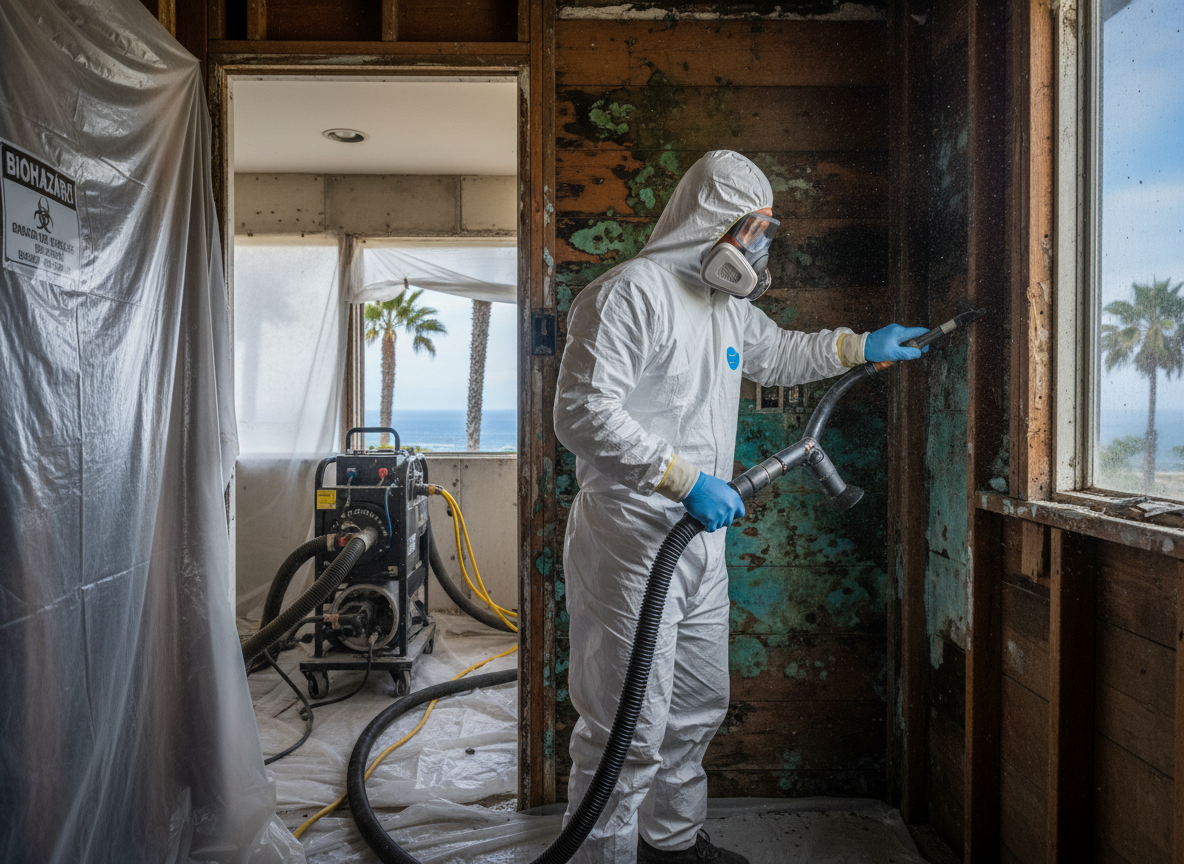
La Jolla homes built before the 1980s often feature crawl spaces and single-pane windows that trap coastal fog and allow stachybotrys and other toxigenic species to colonize behind baseboards and under flooring. The mild Mediterranean climate keeps temperatures moderate year-round, so homeowners rarely notice the slow moisture accumulation until odors or health symptoms appear. Remediation requires negative-air containment and HEPA filtration to prevent spores from migrating into adjacent rooms, especially in attached structures common along La Jolla Shores and Windansea.
Removal protocols differ when porous materials like drywall or insulation are saturated versus when growth is limited to non-porous surfaces. In neighborhoods near Scripps Pier or Mount Soledad, salt-laden air accelerates corrosion of metal HVAC components, creating additional condensation points that must be addressed before clearance testing. Technicians open walls only where moisture meters confirm elevated readings, then dispose of contaminated debris according to San Diego County waste guidelines rather than standard landfill routes.
Post-remediation drying uses dehumidifiers sized for the square footage and monitored daily until relative humidity stays below 50 percent for 48 hours. This step prevents rapid regrowth during the occasional heavy winter rains that reach the coast. Homeowners in Upper La Jolla and Torrey Pines frequently request follow-up inspections after nearby construction disturbs soil and alters drainage patterns around foundations.
Technician insight
In La Jolla, the thing that catches most people out with toxic mold removal is the combination of older stucco homes and persistent marine layer that keeps crawl spaces damp even when the rest of the house feels dry; many owners chase visible spots on ceilings while missing the real source under the slab or behind the shower pan in La Jolla Shores properties.
Hidden Growth Behind Kitchen in Bird Rock
A homeowner noticed a musty smell after winter rains but saw no visible mold. Inspection revealed elevated moisture in the wall behind the sink where a slow leak had soaked the drywall for months. We isolated the kitchen, removed the affected section, treated the framing, and ran drying equipment for three days until readings normalized. Clearance samples passed and the smell did not return.
How it works
- 1
Initial Assessment
Technician arrives within hours, uses moisture meters and borescopes to map hidden growth without disturbing surfaces.
- 2
Containment Setup
Plastic barriers and negative air machines isolate the work zone so spores cannot travel to unaffected areas of the home.
- 3
Source Removal
Affected materials are cut out, bagged, and removed; non-porous surfaces are cleaned with appropriate antimicrobial solutions.
- 4
Drying and Clearance
Dehumidification continues until readings stabilize, followed by independent air sampling to confirm levels meet post-remediation criteria.
Pricing
Pricing varies by square footage affected, whether walls or subfloors must be opened, and access constraints typical of hillside or beach-adjacent properties.